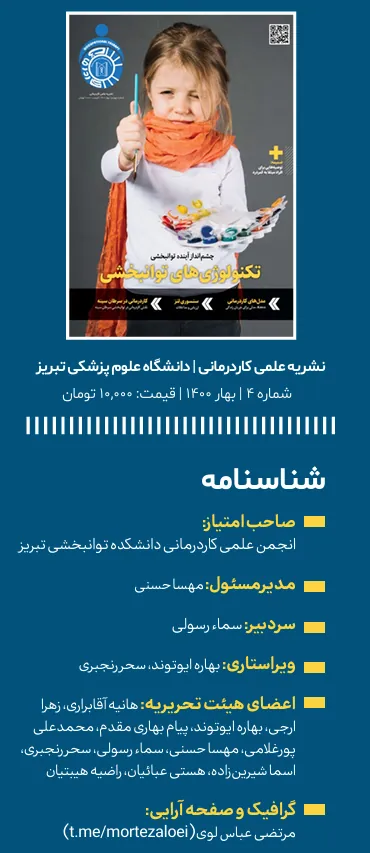
In 2015 he founded "Avijeh Innovators" under the slogan "New Ideas for Change", with three goals: establishing rehabilitation centres, running educational workshops, and designing and manufacturing rehabilitation equipment.
The English text below is a translated summary of the interview. The interview itself, as the journal printed it, is the Persian PDF above.
Dr. Nader Alirezalou, an occupational therapist and specialist in cognitive sciences, is the founder and CEO of the Avijeh Innovative Rehabilitation brand. In this interview, he discusses the development of rehabilitation technologies, local production of rehabilitation devices, and the future of rehabilitation equipment in Iran.
Professional background
Dr. Alirezalou began his work in occupational therapy and rehabilitation in 2005 while studying occupational therapy. During his academic years, he became interested in modern rehabilitation technologies and conducted scientific research in the field of neuroscience and innovative rehabilitation methods. His studies resulted in several ISI scientific publications. In 2015, he founded “Avijeh Innovators” with the slogan “New Ideas for Change.” The institution focused on three major goals:
- Establishing rehabilitation centers
- Conducting educational workshops
- Designing and manufacturing rehabilitation equipment
Rehabilitation equipment and innovations
According to Dr. Alirezalou, direct work with children suffering from cerebral palsy and physical disabilities motivated him to develop technologies that could increase children's participation in therapy and reduce physical strain on therapists. Among the rehabilitation products developed by his team are:
- Space Suit therapy systems
- Spider Cage therapy equipment
- Five-part pediatric exercise systems
- Cognitive rehabilitation packages
- Reverse walkers and mobility devices
These products were designed and manufactured domestically in Iran for the first time.
Entrepreneurship and expansion
Dr. Alirezalou explained that after introducing Spider Cage Therapy in rehabilitation centers, therapists across Iran requested access to the equipment. This demand led to large-scale manufacturing and the establishment of workshops for rehabilitation technology production. His projects were later recognized in entrepreneurship festivals and television programs. With financial support and entrepreneurship grants, the company expanded production and equipped more than 100 rehabilitation centers across Iran. Their products have also been exported to neighboring countries including Azerbaijan, Turkey, and Iraq.
Iran’s position in rehabilitation technology
The interview highlights that many countries in the region depend on imported rehabilitation technologies from Europe and the United States. Dr. Alirezalou believes Iran has strong potential to become a regional producer and exporter because of:
- Skilled young professionals
- Lower production costs
- Availability of technical expertise
- Growing domestic demand
He emphasized that branding and product quality are essential for international competitiveness.
Importance of rehabilitation equipment
Dr. Alirezalou noted that rehabilitation sciences and occupational therapy have changed significantly over recent decades. Modern rehabilitation approaches focus heavily on increasing social participation and independence for people with disabilities. Today, assistive technologies such as electric wheelchairs, reverse walkers, robotic rehabilitation systems and virtual reality systems play a major role in rehabilitation interventions and daily living independence.
Spider Cage therapy
Spider Cage Therapy (also known as Universal Exercise Unit or UEU) was originally developed in Poland in the 1940s. The method aims to improve muscle strength, posture, balance, coordination, and functional movement. According to the interview, this therapy is widely used in neurological rehabilitation, orthopedic rehabilitation, sports medicine, and pediatric rehabilitation. The main goals of Spider Cage Therapy include:
- Normalizing muscle tone
- Increasing active range of motion
- Improving strength and endurance
- Enhancing motor skills and independence in daily activities
The therapy relies on proprioceptive stimulation, active patient participation and continuous treatment sessions.
Advice for students and therapists
Dr. Alirezalou encouraged occupational therapy students and rehabilitation professionals to enter the field of rehabilitation technology and startup development. He stated that occupational therapy education provides knowledge in anatomy, biomechanics, movement science, and disability management, making therapists well suited for innovation and entrepreneurship. He also emphasized that the future of rehabilitation will increasingly depend on technology-based solutions and interdisciplinary collaboration.
Conclusion
At the end of the interview, Dr. Alirezalou thanked the journal and wished success for occupational therapy students and rehabilitation professionals. He expressed hope for continued growth in rehabilitation sciences and rehabilitation technology in Iran.